

When a Basic Split Charge Relay Kit Isn’t Enough
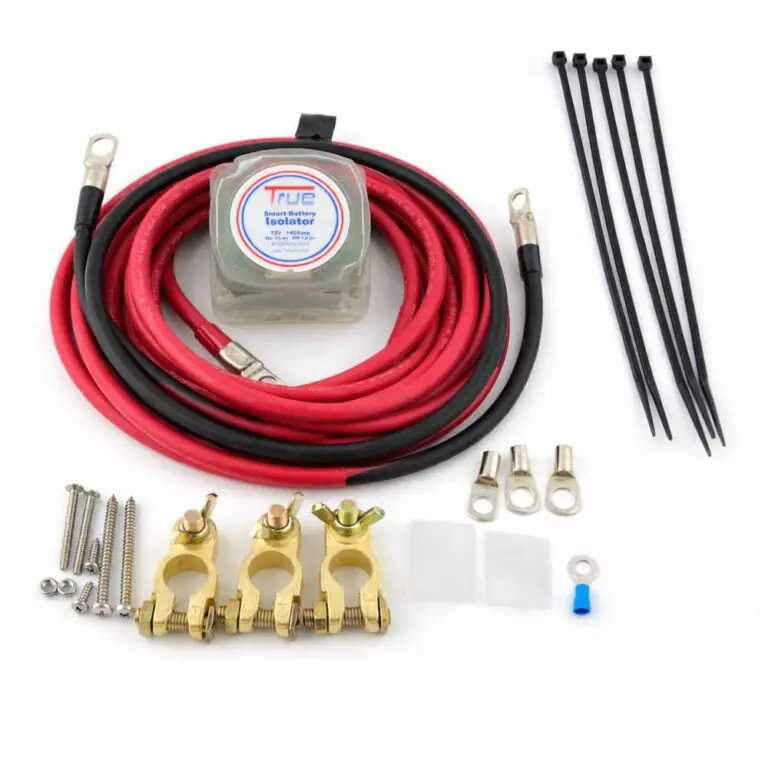
A split charge relay kit is the cheapest and simplest way to run a dual battery setup. It uses a voltage sensitive relay (VSR) to link your starter battery to a leisure battery, so the alternator charges both while you drive.
When the starter battery voltage rises above roughly 13.3 to 13.7 V, the relay closes and connects the two batteries. When the voltage drops, it opens, so your auxiliary battery can’t drain the engine battery. For a small lead-acid leisure battery and light use, a basic split charge kit does the job. Beyond that, it starts to cause problems. Here is where a standard split charge relay kit falls short, and what to use instead.
Where a basic split charge relay kit falls short
 1. Smart alternators. Most vehicles built since about 2015 (Euro 5 and Euro 6 especially) use variable-voltage smart alternators to save fuel. Output can sit at 12.5 to 13 V for long stretches, below the cut-in threshold of a voltage sensitive relay, so the leisure battery barely charges. Some vehicles only raise the voltage during braking or deceleration. If you’ve fitted a split charge relay to a modern van and your leisure battery never seems full, this is almost certainly why.
2. Wrong charge profile. A split charge relay simply passes through whatever the alternator delivers. It can’t do the bulk, absorption, and float stages that a leisure battery needs. Even with AGM or gel batteries, this typically means chronic undercharging and a shorter battery life.
3. Lithium (LiFePO4) batteries. This is the biggest issue. A lithium leisure battery will try to pull very high current through a relay, which can overheat the alternator, cables, and relay contacts. Lithium also needs a specific charging voltage. Most manufacturers advise against connecting lithium batteries directly to the alternator with a split charge relay.
4. Voltage drop over long cable runs. In campervans, motorhomes, and boats where the auxiliary battery sits at the rear, a long run of undersized battery cable can lose 0.5 V or more, so the battery never reaches a proper charge voltage.
5. Mismatched battery chemistries or sizes. A relay ties both batteries together electrically, so a starter battery and a much larger or different-chemistry leisure battery bank can end up working against each other.
The upgrade: a DC-DC charger (battery-to-battery charger)

A DC-DC charger, also called a battery-to-battery charger or B2B charger, sits between the starter battery and the leisure battery. It replaces the relay in your split charge system and solves most of the problems above:
- It boosts low or fluctuating input, so it works with smart alternators.
- It applies a multi-stage charge profile for your battery type, and many units have a dedicated lithium or LiFePO4 setting.
- It limits current, protecting the alternator and wiring.
- It isolates the batteries, so the starter battery is always protected.
Sizing: Common units are 20 A, 30 A, 40 A, and 50 A. Choose based on your leisure battery capacity (Ah) and how quickly you want to recharge. A rule of thumb is a charge current of roughly 20 to 30% of battery capacity for lithium, and less for lead-acid. Make sure the input and output cables are rated for the current, and fit a fuse at both ends.
When a split charge relay kit is still fine
- An older vehicle with a conventional fixed-voltage alternator
- A small lead-acid or AGM leisure battery
- Light, occasional use where you also top up with shore power or solar
If that sounds like your setup, a quality split charge kit with a heavy-duty VSR, correctly sized cable, and fuses is a perfectly good, budget-friendly choice.
Other charging sources for your leisure battery
Even with a DC-DC charger, driving alone often can’t keep up with a fridge, a diesel heater, and a laptop. Consider adding:
- Solar panels with an MPPT solar charge controller, which gives the most useful extra charging for most campervan electrical systems
- A mains battery charger or charger/inverter for campsite hookups
- A battery monitor so you can see your state of charge and know when you need to top up
Quick decision guide
| Your situation | Recommended |
|---|---|
| Older alternator, small lead-acid battery, light use | Split charge relay kit (VSR) |
| Smart alternator (modern vehicle) | DC-DC charger |
| Lithium (LiFePO4) leisure battery | DC-DC charger (essential) |
| Large battery bank or heavy loads | DC-DC charger plus solar |
| Long cable run to rear battery | DC-DC charger, mounted near the leisure battery |